
Meditation
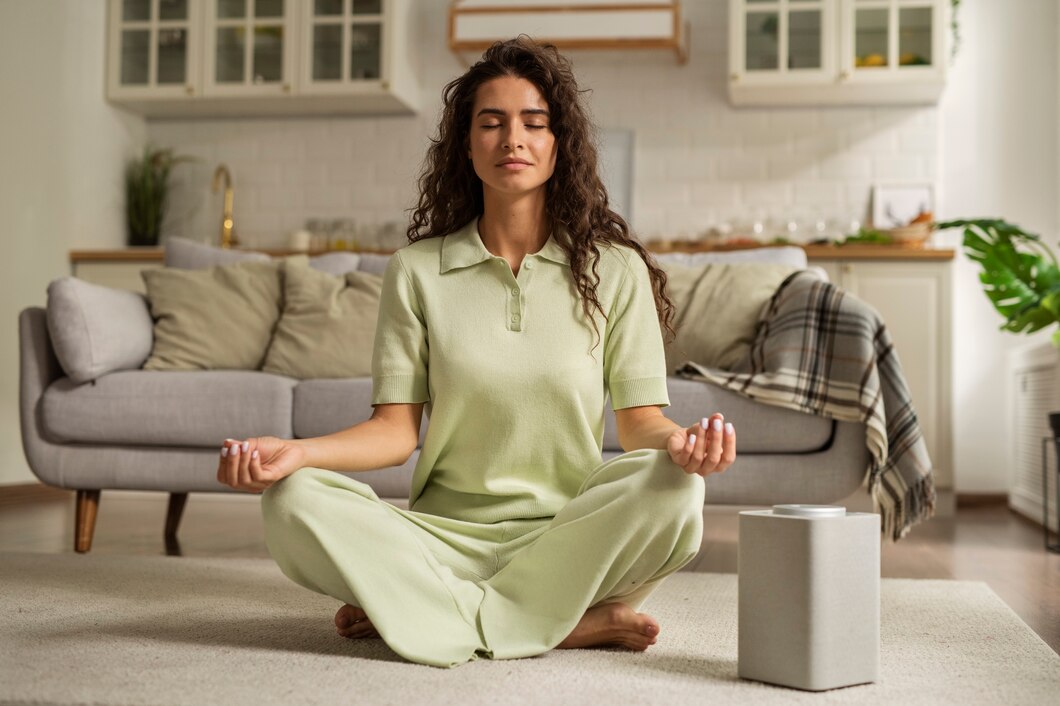
Meditation, principles, and benefits for well-being are of increasing interest to more and more people, notably because 81% of users report an improvement in their health after consulting about mindfulness meditation. We also find that this practice effectively reduces stress in 82% of practitioners.
The benefits of meditation have now been scientifically recognized since the end of the 20th century. Indeed, a study showed that after six months of regular practice, participants saw their cortisol level (stress hormone) decrease by 25%. Moreover, this discipline proves particularly effective in improving the quality of life of people who have suffered a heart attack and in relieving the symptoms of obsessive-compulsive disorder in 79% of users.
In this article, we explore the fundamental principles of meditation as well as its many benefits for your daily well-being. At Hello Soins, our premium appointment-booking platform for alternative medicines such as sophrology or naturopathy, we facilitate your access to these beneficial practices while offering practitioners greater visibility.
What is meditation?
To understand meditation, let us delve into its historical and conceptual richness. This age-old practice represents much more than a simple relaxation technique - it is a complete discipline that engages the mind and transforms our relationship with our thoughts.
Origin of the word and spiritual roots
The term "meditation" comes from the Latin "meditatio" meaning reflection, mental exercise. However, its roots are much older and deeper. In ancient India, meditation (dhyāna in Sanskrit) already constituted a fundamental pillar of spiritual practices more than 5,000 years ago. Furthermore, the oldest written traces date back to the Vedas, Hindu sacred texts dating from around 1500 BCE.
Buddhism then considerably developed and codified these meditative practices, notably with zazen (seated meditation) and vipassana (insight meditation). In parallel, other traditions such as Chinese Taoism or Islamic Sufism developed their own meditative approaches.
Initially, these practices were part of a religious or spiritual framework aimed at awakening, liberation, or union with the divine. The objective was often transcendental - to go beyond the ego to attain a higher state of consciousness.
Evolution toward a secular practice
Since the 1970s, we have witnessed a progressive Westernization and secularization of meditation. Jon Kabat-Zinn, with his MBSR program (Mindfulness-Based Stress Reduction), played a decisive role by extracting meditative techniques from their religious context to adapt them to a therapeutic framework.
Today, meditation is integrated into many fields: medicine, psychology, education, and even business. At Hello Soins, we are seeing growing interest in this practice among patients seeking alternative approaches for their well-being, and our specialized practitioners can support them in this process.
Difference between meditation and relaxation
Although often confused, meditation and relaxation represent two distinct approaches. Relaxation primarily aims at muscular and mental release in order to reduce stress. It is a temporary state of calm that one actively seeks.
Meditation, on the other hand, goes further. It is not so much about reaching a particular state as it is about developing a quality of presence and attention. During a meditation session, the goal is not necessarily to relax (although this may be a beneficial side effect), but rather to observe our thoughts without judgment.
This fundamental distinction explains why meditation produces deeper and more lasting effects on the brain. Unlike simple relaxation, it gradually modifies our mental functioning by cultivating qualities such as attention, self-awareness, and acceptance - skills that persist beyond formal sessions.
In our hyperconnected world, understanding these nuances helps us choose the approach best suited to our specific mental well-being needs.
How does meditation work?
Meditation essentially works as mental training, a workout for the mind that gradually develops our ability to focus and our well-being. Let us discover together the mechanisms that make this age-old practice a powerful tool for inner transformation.
The role of attention and breathing
Breathing is the common thread of any meditative practice. It acts as a natural anchor that stabilizes our body and mind. Indeed, consciously focusing on our breath allows us to divert our brain's resources from stressful thoughts and "clear our heads." Deep (abdominal) breathing activates the secretion of dopamine, providing a feeling of well-being and creating a positive association with the practice.
During meditation, we work to develop two types of attention: focused attention (on an object such as the breath) and open attention (to the entirety of present experience). Each time our mind wanders, we gently bring it back to our object of attention, thereby strengthening our "attention muscle."
The ideal conditions for meditating
For effective practice, certain conditions favor the meditative experience:
-
Appropriate posture: keep the back straight to reflect inner attitudes of confidence and stability. The head, neck, and back should be vertically aligned to avoid drowsiness.
-
Suitable environment: choose a quiet place without distractions, ideally at the same time every day to create a routine.
-
Appropriate time: morning is often preferred because thoughts are fresher, but the key is regularity rather than the chosen time.
The mechanisms of letting go
Letting go is the transformative heart of meditation. It is an attitude of welcome and acceptance toward our thoughts and emotions, without trying to control them. By observing mental chatter without attaching ourselves to it, we gradually create a healthy distance from our thoughts.
This ability to observe without reacting immediately activates the parasympathetic nervous system, which is responsible for relaxation. Thus, rather than fighting our thoughts (which strengthens them), we learn to welcome them in order to transcend them more effectively. This process frees the mind and allows access to a calmer, more centered state of consciousness.
What are the benefits of meditation?
Scientific research now confirms the many benefits of meditation for our body and mind. These positive effects touch several aspects of our overall health.
Reduction of stress and anxiety
Meditation significantly lowers cortisol, the stress hormone. Among regular practitioners, a 25% reduction in this hormone is observed after just a few months. This technique proves particularly effective against anxiety disorders, with efficacy comparable to that of antidepressants, but with fewer side effects. Indeed, 78.6% of patients on medication report adverse effects, compared with only 15.4% among meditation practitioners.
Improved concentration
Meditative practice considerably strengthens our attentional capacity. After only four weeks of using meditation apps, a 14% improvement in concentration is observed. Moreover, a single session can reduce mind-wandering by 22%. This improvement is reflected in better mental clarity and an increased ability to maintain attention on a specific task.
Support in chronic illnesses
For people living with chronic illnesses, meditation represents a valuable therapeutic complement. The MBSR (Mindfulness Based Stress Reduction) program, developed by Jon Kabat-Zinn, helps patients gain a certain degree of autonomy with respect to their illness. The benefits concern various conditions: fibromyalgia, cancer, multiple sclerosis, inflammatory diseases, and autoimmune diseases.
Effects on sleep and pain
Meditation improves sleep quality with efficacy comparable to that of sedatives, but without side effects. It also changes our perception of pain: after only four 20-minute sessions, a 40% reduction in pain intensity and a 57% reduction in the unpleasantness of pain are observed.
Impact on mental health
In the field of mental health, meditation proves effective against depression, notably in preventing relapses. It also reduces the symptoms of post-traumatic stress disorder, obsessive-compulsive disorder, and attention deficit/hyperactivity disorder. At Hello Soins, we observe that these benefits increasingly lead patients to seek practitioners trained in these techniques to complement their care journey.
What types of meditation can be practiced?
Exploring the different forms of meditation helps you find the one that best matches your personal needs. Here is an overview of the main practices accessible to everyone.
Mindfulness meditation
Mindfulness meditation consists of bringing full attention to the present moment, without judgment. This secular approach, popularized by Jon Kabat-Zinn in the 1970s, invites you to observe your thoughts and sensations with kindness. It is generally practiced seated, focusing attention on the breath or bodily sensations.
Moreover, this method integrates easily into daily life - even a few minutes are enough. The goal is not to empty the mind but to welcome what arises with awareness and detachment.
Transcendental meditation
Transcendental meditation (TM), introduced in the West by Maharishi Mahesh Yogi in 1955, uses the silent repetition of a personalized mantra. This technique is generally practiced twice a day for twenty minutes.
Unlike other approaches, it does not rely on concentration or contemplation, but rather aims to reach a state of "pure consciousness" through the repetition of the mantra. A 2008 study notably showed that regular practice could reduce systolic blood pressure by 4.7 mmHg and diastolic blood pressure by 3.2 mmHg.
Buddhist meditation (zazen, vipassana, Tibetan)
Buddhist practices offer various meditative approaches. Zazen (Japanese Zen meditation) invites one to sit facing a wall, in silence, attentive to posture and breathing. Vipassana meditation, older still, develops "insight" by observing mental and bodily phenomena. As for Tibetan meditation, it combines chiné (mental pacification) and lhaktong (superior vision).
Guided meditation or visualization
Guided meditation uses the voice of an instructor who accompanies the practitioner, in person or via a recording. This method, particularly accessible to beginners, can incorporate visualizations (creating soothing mental images) to reduce anxiety and promote relaxation.
Moving meditation (walking, yoga)
Meditation is not limited to a seated position. Breathwalk (breathing coordinated with walking) is a yoga-derived technique that harmonizes breathing and movement. Likewise, mindfulness walking consists of bringing total attention to each step, synchronizing breathing and movement.