
Moxibustion and cupping
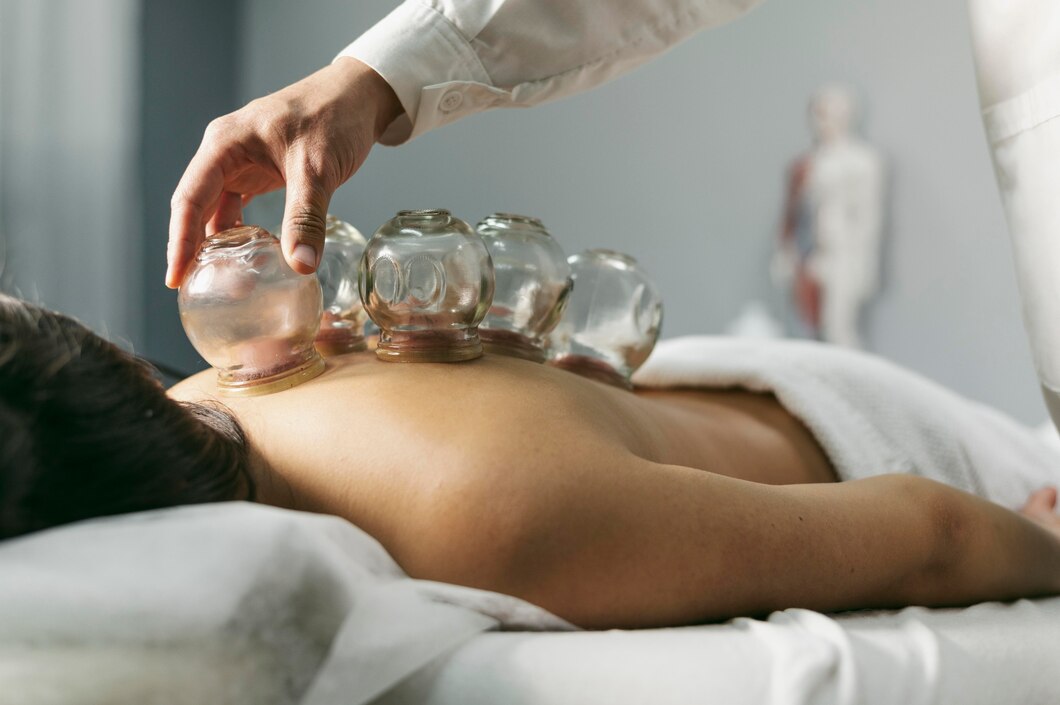
Moxibustion and cupping, principles and benefits for well-being, are ancestral techniques that are enjoying a considerable resurgence of interest today, particularly among Olympic athletes and celebrities. These two practices from traditional Chinese medicine offer natural approaches to relieving various ailments and improving our overall health.
Moxibustion, a technique that consists of heating acupuncture points with dried mugwort, offers many benefits, particularly effective against cold-related conditions. Its targeted action on specific moxibustion points makes it possible to effectively treat painful periods, premenstrual syndrome, as well as digestive problems such as constipation and bloating. For their part, cupping, which is gradually becoming more widespread in the West and in physiotherapy, is recognized for its analgesic, decongestant, and anti-inflammatory effects. These methods stimulate blood circulation, promote the elimination of toxins, and support the lymphatic system.
At Hello Soins, we are seeing growing interest in these alternative practices. Our premium platform facilitates connections between patients and qualified practitioners in these fields, making it possible to explore these traditional methods safely and with personalized follow-up.
Origins and foundations of the two practices
The roots of moxibustion in Chinese medicine
Moxibustion has its roots in ancient China, well before modern acupuncture. This ancestral technique is mentioned in the Huangdi Nei Jing, the oldest known work of Chinese medicine, under the name Pienn Tsiou (砭灸 biānjiǔ), which George Soulié de Morant translated as "stone needles and moxas." Interestingly, the use of stone needles preceded that of metal needles, thus testifying to the remarkable antiquity of this practice.
It was mainly during the Ming dynasty that moxibustion underwent considerable development, used in conjunction with acupuncture. At the end of the 17th century, it crossed borders to appear in Europe, where authors such as Hermann Busschof and Willem ten Rhijne praised its merits against gout. In the 19th century, France adopted it to treat various chronic illnesses and stimulate the nervous system. The ultimate recognition of this practice came in 2010, when UNESCO inscribed it on the Intangible Cultural Heritage of Humanity.
The thousand-year history of cupping
At the same time, cupping therapy also has a fascinating history. The first to use it systematically were the Egyptians, around 1550 BC, as evidenced by the Ebers papyrus. This practice then spread across different civilizations.
In ancient Greece, Hippocrates and Galen used it regularly. In the Middle East, it developed under the term Al-hijamah (or hijama), mentioned in the medical writings of Al-Razi, Ibn Sina (Avicenna), and Ibn al-Quff. Nevertheless, this therapy experienced a renewed boost during the 2016 Olympic Games, when the whole world discovered the distinctive marks on swimmer Michael Phelps's body.
Over the centuries, the materials evolved: cow horns, bamboo, copper, brass, and glass, each bringing its specific properties to the treatment.
Shared energetic philosophy
These two practices, despite their technical differences, share a common energetic philosophy rooted in traditional Chinese medicine. They are based on the fundamental concept of Qi, the vital energy that circulates in the body through specific meridians.
Chinese thought considers that any imbalance between Yin and Yang can cause illness. Consequently, both moxibustion and cupping aim to restore this energetic harmony. These techniques do not separate the body from the mind, adopting a holistic approach to well-being.
As this philosophy puts it: "Qi is the commander of blood, blood is the mother of Qi." This view perfectly illustrates the interdependence of the energies that these two practices seek to balance in order to promote overall health.
How moxibustion and cupping work
The techniques of moxibustion and cupping are based on simple but effective principles. These complementary therapeutic methods each act differently to stimulate the flow of energy and blood circulation in the body.
Direct and indirect moxibustion
Moxibustion mainly uses dried mugwort (moxa) as a source of heat. There are two distinct approaches. In direct moxibustion, small cones of mugwort are placed directly on the skin and lit at the top. The practitioner removes them as soon as the patient feels intense heat, without ever burning the skin. This operation can be repeated up to eight times on each point.
By contrast, indirect moxibustion uses sticks or "cigars" of mugwort held a few centimeters from the skin. Some techniques also combine acupuncture and moxibustion by attaching a small ball of moxa to the handle of a needle already inserted.
Hot and cold cupping
For cupping, two methods predominate. Hot cupping uses a brief flame inside the glass cup to create a vacuum, causing a suction effect when it is placed on the skin. Thus, the skin is drawn into the cup, promoting local blood circulation.
At the same time, cold cupping uses an air pump to create suction, without using a flame. This more modern method is particularly appreciated for its practicality.
Application points and targeted areas
The moxas are applied to specific acupuncture points corresponding to the conditions being treated. In addition, cupping is often placed on the back, the trapezius, the lower back, the neck, or along the energy meridians. Point 36E (Zu San Li) is particularly recommended for boosting energy.
Duration and frequency of sessions
A moxibustion session generally lasts between 30 minutes and one hour. For cupping, application varies from 5 to 15 minutes depending on the intensity of the condition and the patient's sensitivity. The frequency of treatments depends on the problem being treated — some require weekly sessions, others two-week intervals.
On the Hello Soins platform, we connect patients with qualified practitioners so they can benefit from these ancestral techniques under the best conditions.
Benefits for body and mind
The therapeutic benefits of moxibustion and cupping extend far beyond simple temporary relief. These practices offer a comprehensive approach that acts simultaneously on several aspects of our health.
Relief of muscle and joint pain
Cupping allows for immediate release of muscle tension, particularly in the back, shoulders, and neck. Its muscle-relaxing action promotes the release of fascia and the elimination of toxins accumulated in the tissues. For its part, moxibustion provides beneficial heat that penetrates deeply, thus relieving chronic pain from osteoarthritis and rheumatism.
Improved blood circulation
By creating local vasodilation, these two techniques significantly increase blood flow in the treated areas. This effect is particularly valuable for speeding recovery after exertion in athletes and for improving tissue oxygenation.
Effects on digestion and transit
The stimulation of specific points by moxibustion helps regulate the digestive system. For example, working on the Zhongwan point (located in the middle of the abdomen) strengthens digestive energy, thus reducing bloating and feelings of heaviness after meals.
Stress reduction and relaxation
Beyond the physiological benefits, these methods provide deep relaxation. The gentle warmth of moxibustion and the decongestant effect of cupping promote the release of endorphins, thus reducing anxiety and improving sleep quality.
Support for the immune system
These practices strengthen our natural defenses by stimulating lymphatic circulation and facilitating the elimination of toxins. The action on certain moxibustion points such as Zusanli (36E) particularly helps boost immunity.
Moxibustion benefits: focus on menstrual disorders
Moxibustion stands out for its remarkable effectiveness against menstrual disorders. It relieves dysmenorrhea (painful periods) by warming the uterus and promoting better blood circulation in the pelvis. It also regulates irregular cycles and eases premenstrual symptoms such as irritability and water retention.
At Hello Soins, we facilitate connections between patients and qualified practitioners in these ancestral techniques. Our premium platform makes it easy to find a specialist able to adapt these methods to your specific needs, while benefiting from personalized follow-up through our messaging service.
Precautions, contraindications, and supervision
Despite their many benefits, moxibustion and cupping require certain precautions to ensure safe and effective practice.
When should these practices be avoided?
These techniques are not suitable for every situation. Moxibustion is contraindicated in cases of fever, severe headaches, or excessive sweating. It should be avoided on recent surgical scars and joints that are already red and hot. In addition, wait at least two hours after a meal before a session.
As for cupping, it is not recommended for:
-
People on anticoagulants
-
Pregnant women and children under 10 years old
-
Elderly people or those suffering from heart problems
-
Areas with ulcers, wounds, skin infections, or sunburn
In addition, never apply cups on veins, lymph nodes, varicose veins, or eyes.
Possible side effects
Moxibustion can cause minor burns if performed incorrectly. For cupping, circular red marks always appear but generally disappear within a few days. However, some people may experience dizziness, nausea, or localized pain after a session. In rare cases, bruising or scars may form.
Importance of a trained practitioner
These ancestral techniques require rigorous training. A qualified practitioner knows the risks and knows how to minimize them while optimizing therapeutic effects. As the Medical Association points out, "the main danger lies in diverting patients with serious conditions away from treatments whose effectiveness has been scientifically proven."
Using over-the-counter kits without proper training presents considerable risks. Ideally, these practices should be carried out by professionals trained in traditional Chinese medicine, osteopaths, physiotherapists, or doctors.