
Foot / hand / facial reflexology
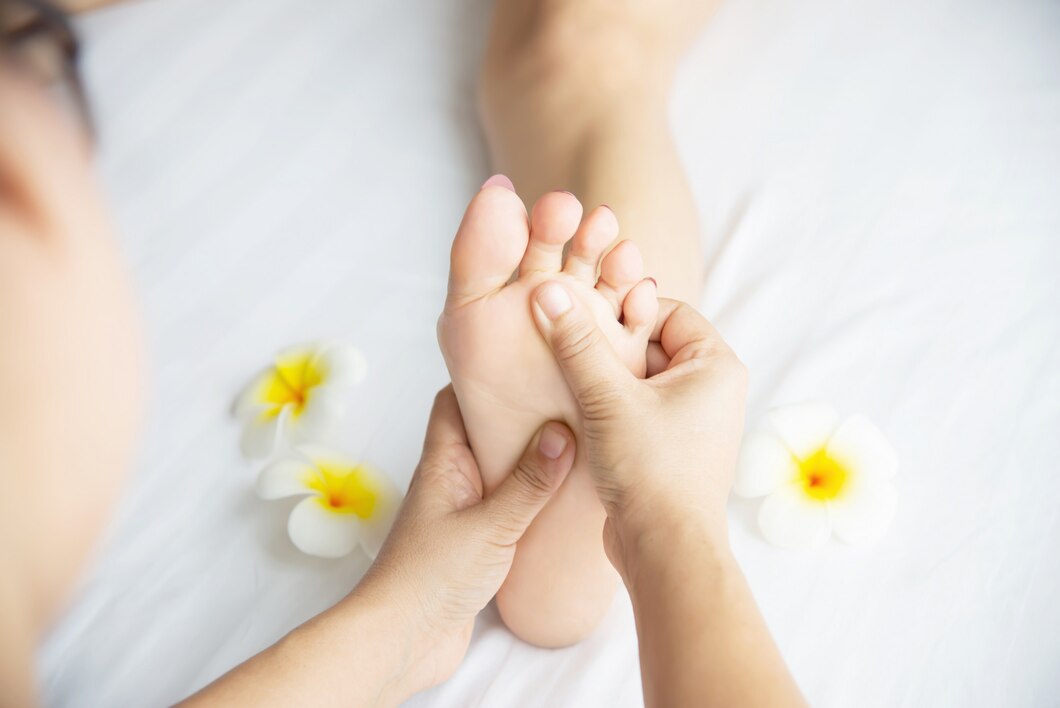
Did you know that 80% of people who consulted for reflexology noticed an improvement in their health? Foot / palm / facial reflexology, principles and benefits for well-being, is a therapeutic practice whose origins date back to ancient Egypt and which developed in China around 3000 BC. At Hello Soins, we are convinced that this age-old approach deserves to be better known for its many benefits on overall health.
What exactly is reflexology? This technique is based on the stimulation of reflex points located on different parts of the body, notably the feet, hands, ears and face. Hand reflexology, for example, makes it possible to stimulate up to 3,200 nerve endings! Moreover, reflexology offers many benefits: reduced anxiety, improved sleep, relief from premenstrual symptoms, support during pregnancy and reduced stress. In this article, we explore this practice in detail and its multiple applications for your well-being.
What is reflexology?
Reflexology is an ancient manual practice based on a fundamental principle: our body is reflected in certain specific areas. Unlike simple relaxation, this therapeutic approach aims to precisely stimulate these areas in order to restore the body's balance.
Definition and basic principles
Reflexology is a natural technique belonging to alternative medicine that consists of applying pressure to certain reflex areas of the body to stimulate physiological functions and promote well-being. This practice is based on the idea that every part of the body is represented in specific areas located mainly on the feet, hands, face and ears.
The prefix "reflex" should be understood in the sense of "reflection" - that is, the projection of the human body into a small part of it. For example, if we observe the foot "standing up," we notice that its arch follows exactly that of the spine, as if the whole organism were seated there.
For a reflex phenomenon to occur, three elements are necessary:
-
A receptor (the skin or mucous membranes)
-
A transmission pathway (specific branches of the nervous system)
-
An effector located at a distance (a muscle, a gland, an organ)
Reflex zones and their role
Reflex zones are precise points that correspond to all the organs, muscles, bones and glands of the body. The feet contain about 7,200 nerve endings, while the hands have 3,000, which explains why foot reflexology is the most widespread.
In practical terms, the mapping of the body is projected as follows:
-
On the right foot are the reflex zones of the organs on the right side of the body
-
On the left foot are those of the organs on the left side
-
On both feet are the zones of organs that exist in pairs or are located in the middle of the body
By stimulating these points, the reflexologist sends a message to a specific organ. This dialogue is established through feedback, which allows the organ to receive the request to restore balance and regain its optimal equilibrium.
Differences between reflexology and classical massage
Classical massage and reflexology differ fundamentally in their conception and practice. Here are the main distinctions:
Purpose: Reflexology has a precise therapeutic goal - to treat specific pathologies or an organ in distress. By contrast, traditional massage aims more at general relaxation and stress relief.
Approach: Reflexology uses targeted pressure techniques on specific areas, whereas massage works more broadly on muscle tissues.
Mechanism of action: Energy massage aims to circulate blocked energies through meridians, those invisible pathways taken by energy. For example, constipation will respond to classical colon massage, whereas an energy massage will focus on the meridians and energy points connected to the digestive system.
To choose between these two approaches, it all depends on your needs: if you are looking for a precise action on specific problems, reflexology will be more suitable, whereas for overall relaxation, classical massage will be better.
The three main forms of reflexology
Each form of reflexology offers a unique approach to balancing our body. Let us discover together these three complementary methods that offer specific benefits depending on your needs.
Foot reflexology: how it works and indications
Foot reflexology is the most widespread technique in the West. It considers our feet to be a true miniature map of our entire body. Each foot reflects one half of the body, with a very detailed mapping of the organs, glands and systems. By stimulating these reflex zones, the practitioner can tap into the body's natural self-regulating capacities.
This method is suitable for everyone and, in addition to appropriate medical treatment, helps soothe many imbalances. It is particularly effective for chronic disorders such as sleep problems, back pain or digestive issues. Moreover, it acts deeply on blood and lymphatic circulation, thereby promoting the elimination of toxins.
Hand reflexology: for whom and why
Less well known but just as effective, hand reflexology works on the palms, which contain no fewer than 3,000 nerve endings. This technique is ideal for sensitive people such as seniors, children or pregnant women (after the first trimester).
It also has the advantage of being easily accessible for self-massage. You can therefore quickly manage a spike of stress or relieve certain ailments such as asthma, allergies or even sciatica. In fact, for the latter, it is enough to massage the end of the long bone that forms the 5th finger, near the wrist. It is a particularly relaxing technique that provides immediate benefit.
Facial reflexology: benefits and specific features
Facial reflexology or Dien Chan (its Vietnamese name) focuses on the 300 reflex points of the face. Its particularity is that it acts directly on the central nervous system, making it a preferred approach for psychological and emotional disorders.
Especially recommended for people who are "too much in their minds," it is effective against migraines, insomnia and anxiety. By stimulating certain precise points, such as the bridge of the nose which corresponds to the spine, one can quickly feel more relaxed. In addition, it is often integrated into holistic wellness approaches for its ability to provide an immediate sensation of mental and physical lightness.
What are the benefits of reflexology?
The power of reflexology lies in its ability to act on multiple aspects of our health. Thanks to a holistic and personalized approach, this practice offers remarkable results validated by scientific research.
Reduction of stress and anxiety
Reflexology proves particularly effective against stress and anxiety. In 2015, a comparative study showed that reflexology was as effective as hypnosis and more effective than music therapy in reducing anxiety, with an immediate drop of 16 points on a scale from 20 to 80. By targeting specific areas, notably those linked to the pituitary gland, hypothalamus, diaphragm and adrenal glands, the practitioner promotes the release of endorphins that bring a feeling of deep well-being.
Improved sleep and digestion
A meta-analysis published in the Journal of Advanced Nursing in 2020 confirmed the significant effect of reflexology on sleep quality. By stimulating the reflex zones linked to the digestive system, this practice also improves bowel transit and relieves disorders such as bloating and constipation. Moreover, studies carried out on children suffering from constipation showed that after six foot reflexology sessions, their transit had improved considerably.
Relief from chronic pain
Reflexology provides considerable relief for people suffering from persistent pain. By acting on certain areas of the nervous system, it modulates pain signals transmitted to the brain. Patients with fibromyalgia report in particular a significant reduction in their pain after regular sessions. In addition, by improving blood circulation, it helps oxygenate tissues and eliminate toxins, thereby reducing the inflammation responsible for many chronic pains.
Support for hormonal disorders
For female hormonal imbalances, reflexology offers valuable support. By stimulating the reflex zones of the endocrine glands (pituitary, ovaries, thyroid), it helps regulate the hormonal system. An Iranian study showed that reflexology was more effective than ibuprofen in reducing the intensity and duration of menstrual pain. At menopause, it helps reduce hot flashes, anxiety and sleep disorders by regulating body temperature and the circadian cycle.
Support in cases of serious illness
Reflexology does not claim to cure serious illnesses, but it can considerably improve patients' quality of life. In oncology, it helps alleviate side effects of treatments such as nausea and fatigue. A less stressed and more rested body tolerates treatments better and fights the disease more effectively. In cases of fibromyalgia, it improves sleep quality, relieves muscle pain and regulates emotions, especially anxiety.
Through Hello Soins, we connect patients with qualified reflexologists to ensure optimal results tailored to each situation.
How does a reflexology session take place?
Are you wondering how a reflexology session actually works? Let us discover together the key stages of this therapeutic experience, from the first appointment to the potential reactions after the treatment.
First consultation: listening and diagnosis
First of all, the initial consultation begins with an in-depth interview. The reflexologist will ask you about your medical history and your general state of health. This exchange, which can last up to 20 minutes, aims to determine the energetic origin of your imbalances and to define a personalized protocol. At Hello Soins, we stress the importance of this listening phase, which makes it possible to adapt each session to your specific needs.
Stimulation techniques used
Next, the practitioner generally begins with a gentle massage to relax the area to be treated before moving on to specific techniques. The methods used vary according to needs:
-
Manual stimulation with pressure and crawling movements
-
The use of tools such as the glass stick or the manual detector
-
Sometimes moxibustion (heat) for certain reflex points
These techniques aim to activate the lymphatic and venous systems, then apply stronger pressure to the targeted areas.
Duration and frequency of sessions
A standard session lasts about 45 to 60 minutes for an adult. However, this duration varies according to the profile:
-
5 to 15 minutes for infants
-
15 to 30 minutes for children
-
30 to 40 minutes for elderly people or those with serious illnesses
As for frequency, it depends on the objective. For a preventive approach, a monthly or seasonal session is recommended. For curative treatment, 3 to 5 sessions spaced 7 to 15 days apart are generally necessary, followed by monthly or quarterly maintenance.
Possible reactions after a session
Moreover, after a session, different reactions may occur within 24 to 48 hours. These "elimination crises," though sometimes unpleasant, are often a sign that the body is adjusting. Among the possible reactions:
-
Fatigue or, conversely, a boost of energy
-
More frequent need to urinate
-
Temporary worsening of symptoms before improvement
-
Emotional release (sadness or euphoria)
I recommend staying well hydrated after the session to facilitate toxin elimination and resting if necessary.
Conclusion
Reflexology therefore represents a complete therapeutic approach that fits perfectly within a holistic wellness approach. Certainly, this age-old practice has proven itself in stress management, improving sleep and relieving chronic pain. We have also seen that the different forms of reflexology - foot, hand and facial - each offer specific advantages suited to various needs and sensitivities.
Contrary to common belief, reflexology is not limited to simple relaxation. In fact, it is a true therapeutic method that stimulates the body's natural self-healing abilities. The many studies cited above also confirm its effectiveness in supporting a variety of disorders, from hormonal imbalances to more serious conditions.
To fully benefit from the advantages of reflexology, however, it is essential to consult a qualified practitioner. That is why Hello Soins is committed to putting you in touch with certified reflexologists who will be able to respond precisely to your needs. Our premium platform not only allows you to find the ideal practitioner, but also gives you access to the best appointment slots and enables personalized follow-up thanks to our integrated chat service.
Beyond simple appointment booking, we offer real support throughout your wellness journey. Practitioners, for their part, benefit from optimized schedule management and increased visibility to help grow their patient base.
Ultimately, whether you want to relieve a specific problem or simply take care of your overall health, reflexology is a gentle and natural approach whose positive effects often appear from the very first session. Do not hesitate to take the plunge and discover for yourself the many benefits of this ancient practice, now accessible in just a few clicks thanks to Hello Soins.